Project Chlorine and Project Training Wheels 2016

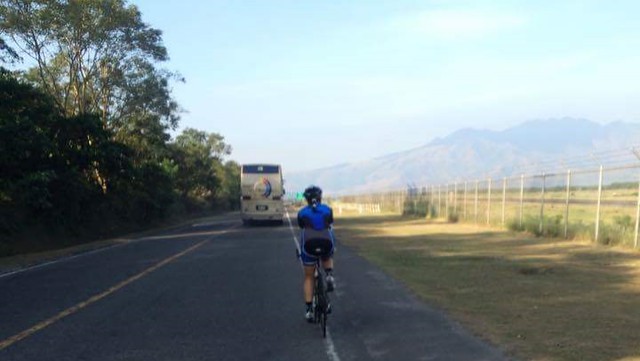
The second weekend of January brought an opportunity to welcome a new teammate to Team Endure. Roselle, also known as the Running Diva has long been a friend of Endure and had already been participating in aquathlons since before I took up triathlon. This year, her target is to race Ironman 70.3 Philippines as an individual competitor so we took Saturday to drive up to Subic to ride those smooth traffic-free roads, and then practice some open-water swim skills and drills.
Team Endure Mini Camp
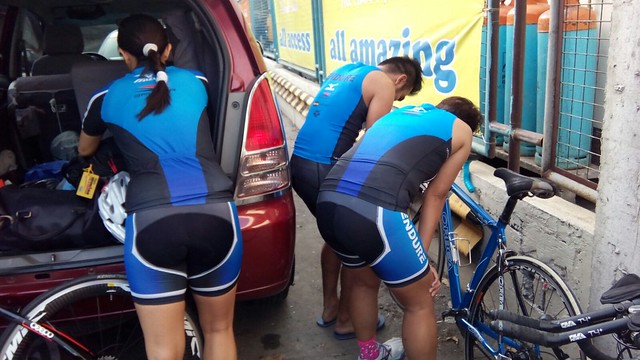
Getting our bikes ready.

Team Endure Mini Camp
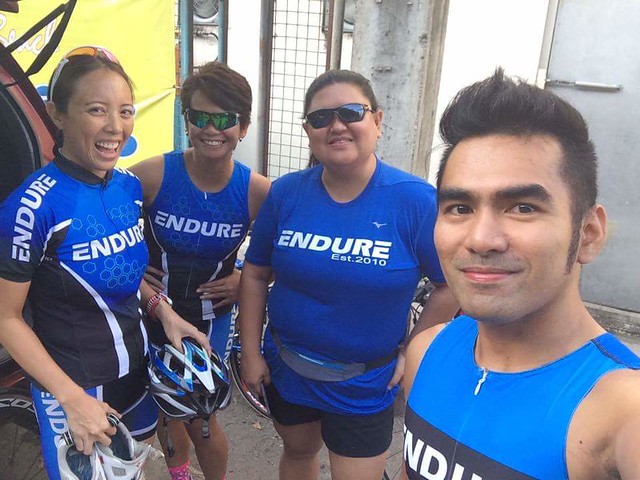
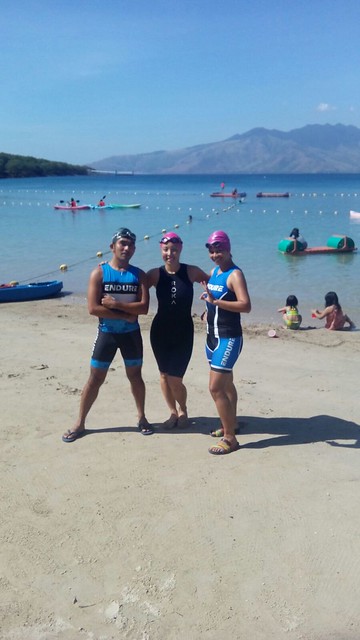
with Roselle, Marga, and Clark

Team Endure Mini Camp
My bike Aki’s first time back in Subic in a long while!
Team Endure Mini Camp
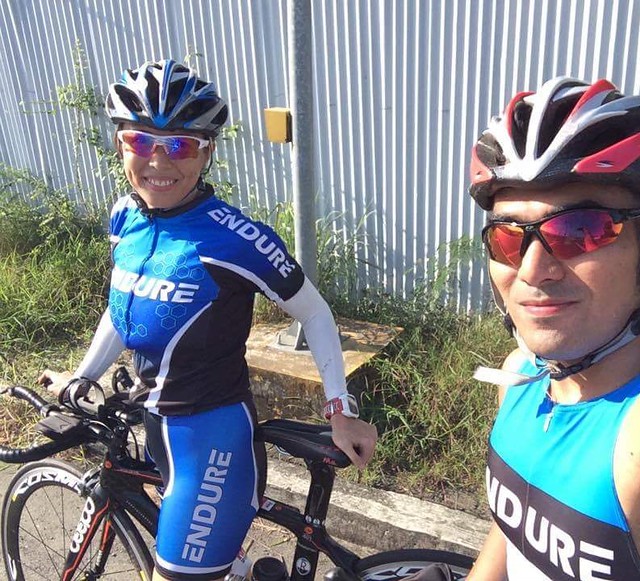
leading the way

I took some time to help Roselle familiarize herself with bike shoes and clipping into her pedals after our ride. Although she already has the bike shoes, she still rides in running shoes. To help her conquer her fear, I broke down the motion of clipping in and pushing off into the following steps:

  1. While standing astride your bike’s top tube (not seated on the saddle), clip in your dominant foot — it’s the one you are most comfortable pushing down on the pedal with.
  2. Push down with the clipped foot and scoot along, pushing off the ground with the free foot.
  3. As you gain momentum, lift yourself and ease back onto your saddle.
  4. Place the free foot on its pedal and start pedaling. You don’t need to clip in yet.
  5. Kick the free pedal to align the cleat and the clipping surface, and clip in.
    1. To stop, she would need to unclip with her non-dominant foot, lift herself off her saddle and bring her body forward while braking so she could put the unclipped foot on the ground in front of her.

      Though tremulous and hesitant, Roselle quickly mastered this procedure. Now all she needs to do is keep practicing to make the whole thing fluid and automatic.
      Team Endure Mini Camp
      at All Hands Beach to learn drafting, deep-water starts, beach starts, and swim exits

      While the usual beach for open water swim sessions used to be Dungaree (which was rebranded as Sands of Triboa and now ACEA Resort), it’s currently closed to the public until partway through summer. We paid P500 each for day trip beach access to All Hands Beach, and the cordoned-off beach area was perfect for teaching. The water was also clear and clean and surprisingly cool, which was refreshing after our hot ride out.

      As veteran athletes we may take some skills and knowledge for granted, but for those new to the sport, they actually aren’t commonsensical. You can’t do triathlon for six years and not learn anything, so I did my best to pass down some veteran moves learned from trial-and-error and from those who do this sport for a living. It was highly gratifying to see my teammates absorb everything like sponges, and I hope it comes in useful come race day.

Swim Equipment

Swimming goggles are practically important part of your swimming gear. It protects your eyes from damage and see where you are going.  There are lots of styles of swimming goggles, so consider the fit when you are buying.


Swim caps are worn in order to protect loose hairs which fall from the scalp of swimmers who are not wearing a cap. Competitive swim caps are made of tightly fitted silicone, latex, or lycra that hugs the skull of its user, providing cover for his or her hair. This reduces drag in the water caused by loose hair. During longer swimming sessions, a swim cap keeps the head warm.


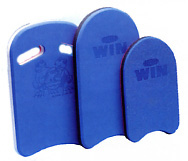
Kickboards is a bouyant use to support a swimmer’s upper body and arms while allowing free kicking movements. There are many types of kickboards. Most are made of foam and come in a variety of shapes and sizes.  Using a kickboard for drills in swimming can improve you leg strength. Kick your legs to propel yourself around the pool while your upper body floats on the water.

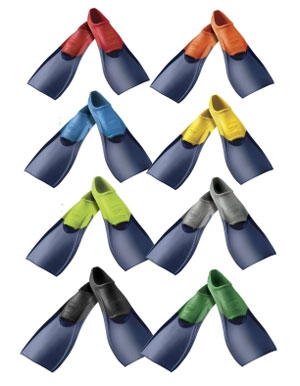
Swimming fins is a way for swimmers to improve kick strength, ankle flexibility, body position, and go faster during a swim practice. Fins or flippers come in hundreds of shapes, colors, fastenings, and sizes; different fins will do different things for (and to) you. Short or small bladed fins, allow you to maintain a foot speed closer to your regular kicking speed with no fins.

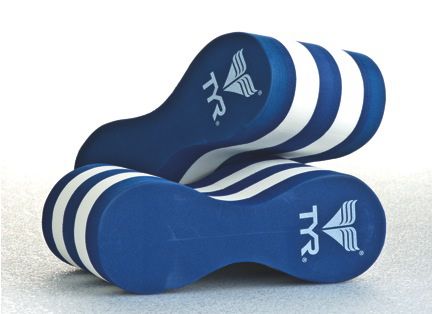
Pull buoys are figure-eight shaped pieces of foam, though they come in other configurations, too. Pull buoy is a point of a pool tool that it helps you focus on a particular aspect of your stroke. So when you’re pulling, pick one part of the pull — hand entry, catch, elbow, release point, etc. — and pay attention to it.


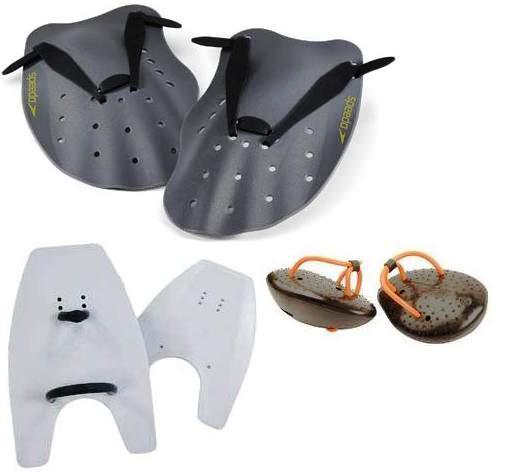
Swim paddles can help you get a feel for your buoyancy in the water and allow you to use it in a way you might not have before. Adding paddles to either swimming or pulling can increase speed and feel, making some stroke flaws more obvious. Using paddles also adds an extra load to the workout, which can result in improved conditioning


Consolidated from different online sources.

Swim Exit 101

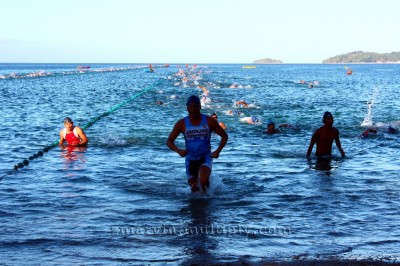
Darwin while exiting the water (Photo courtesy of Marvin Opulencia)

Exiting the open water is an often ovelooked part of the transition from swim to bike.  Many seconds can be gained and lost, so technique and planning are important.

Step 1: Swim toward the finish. Know the course and find tall buildings, trees or signs to sight that are in line with the swimexit.

Step 2: Activate your legs. Kick a little extra during the last 200 meters of the swim.

Step 3: Keep swimming! Don’t stop or standing up until you have run aground in the shallow water. When your fingers scrape the bottom, take a few more strokes by pulling right under your torso.

Step 4: Stand up and lift your goggles onto your forehead. This action clears your vision for any potential hazard underfoot as you start to run out of the water.

Step 5: Take off your cap and goggles when you see your bike. Abandonment of equipment can result in a penalty, so don’t risk dropping these small items.


Source: Triathlete Magazine